Falls are so common among older adults that it is easy to start thinking of them as inevitable — as something that happens with age, something you brace for rather than prevent. That assumption is worth setting aside entirely, because it is both wrong and costly.
Falls are the leading cause of injury-related death among adults ages 65 and older, and the fall death rate is increasing. In 2024, 43,020 individuals aged 65 and older died as a result of preventable falls, and in 2023, over 3.85 million were treated in emergency departments due to fall-related injuries. Those numbers are sobering. What is less often said is the most important thing: through practical lifestyle adjustments, evidence-based falls prevention programs, and clinical-community partnerships, the number of falls among older adults can be substantially reduced.
This post covers the practical steps most likely to make a difference — in your home, in your body, and in your relationship with your own medical team. It also covers local programs that can help, some of them at no cost.
Understanding the Risk
Falls rarely have a single cause. They are almost always the result of multiple factors combining in a moment — a loose rug, a medication that affects balance, a poorly lit hallway, a moment of inattention. Risk factors for falls include muscle weakness, a history of falls, use of four or more prescription medications, use of an assistive device, arthritis, depression, age older than 80 years, and impairments in gait, balance, cognition, and vision.
Falling once doubles your chances of falling again. That is one of the most important statistics in fall prevention, and one of the most actionable — because it means that a first fall is not just an event to recover from but a signal that something needs to change.
Fear of falling is itself a risk factor. Older adults who are afraid of falling tend to move less, which weakens the muscles and balance that protect against falls, creating a cycle that makes the fear self-fulfilling. The goal of fall prevention is not to be more careful in a limiting sense — it is to be genuinely safer, which usually means being more active and more engaged, not less.
Start With Your Home
The majority of falls among older adults happen at home, during ordinary activities. That is the bad news. The good news is that most home hazards are fixable, many inexpensively.
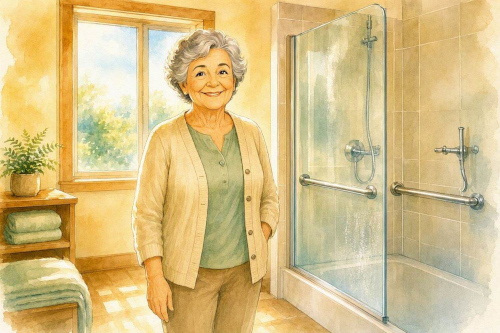
The bathroom is the highest-risk room in most homes. Installing professionally mounted grab bars near toilets and inside showers provides stable support during transfers that often challenge balance. Non-slip mats, walk-in showers, handheld showerheads, and shower chairs can further reduce slipping hazards while making daily routines more comfortable. One important caution: towel bars are not grab bars. Traditional towel bars can break if used as a grab bar and need to be attached in the right way with blocking in the walls. Grab bars must be professionally installed into wall studs to bear weight safely.
Lighting is one of the most overlooked fall hazards. Many falls happen in poorly lit areas where hazards go unnoticed. Installing bright, energy-efficient lighting in hallways, staircases, and entryways is a high-priority improvement. Motion-sensor lights that turn on automatically when you enter a room eliminate the need to fumble for switches in the dark. Consider swapping traditional switches for glow-in-the-dark or illuminated switches, and turn on the lights before going up or down stairs.
Rugs and floor surfaces account for a significant number of falls. Check that all carpets are fixed firmly to the floor so they won’t slip, and put no-slip strips on tile and wooden floors. Avoid throw rugs or small area rugs entirely. If you have rugs you are unwilling to part with, non-slip rug pads should be underneath all rugs, and double-sided carpet tape on the edges prevents them from moving or rolling up.
Walkways and clutter deserve a deliberate look. Throw rugs that curl at the edges, extension cords stretched across walkways, stacks of magazines, pet toys, and cluttered hallways can all create unexpected obstacles. Taking an afternoon to clear walking paths and rearrange furniture for wider pathways can immediately improve home safety.
Stairs require particular attention. Home modification interventions for stair safety include installing handrails on both sides of the stairs or long hallways. Having lighting at both the top and bottom of the stairs — with a light switch at each end — keeps you prepared regardless of which direction you are going.
Storage habits matter more than most people realize. Keep frequently used items between your waist and shoulder height to reduce the need to reach overhead or bend low, both of which challenge balance. A sturdy step stool with a handle — not a chair or a stack of books — should be the only thing used to reach higher items, and even then, caution is warranted.
Talk to Your Doctor
Many fall risk factors are medical in nature and require a conversation with your healthcare provider rather than a trip to the hardware store.
Your healthcare team can review your medicines for side effects and interactions that may increase your risk of falling. To help with fall prevention, your care team may consider weaning you off medicines that make you tired or affect your thinking — these include sedatives, antihistamines, and some types of antidepressants.
The use of benzodiazepines in older adults increases the risk of night falls and hip fractures by 44%. Antiarrhythmics, digoxin, diuretics, sedatives, and psychotropics also increase the risk of falling substantially. If you are taking any of these medications and have not discussed fall risk with your doctor, it is worth raising at your next appointment.
Vision is another medical risk factor that is frequently under-addressed. People with poor vision may struggle to see objects and adapt their gait to avoid them, or may misjudge the position of step edges or lack of balance when navigating the environment. The main causes of poor vision in older adults include uncorrected refractive error, cataracts, glaucoma, and retinal degeneration. A current eyeglass prescription and regular eye exams are a meaningful part of fall prevention.
Low blood pressure upon standing — called orthostatic hypotension — is a common and under-recognized fall risk, particularly in people taking blood pressure medications or diuretics. If you feel lightheaded or dizzy when you stand up, tell your doctor. The fix is often straightforward.
One thing many older adults do not know: more than one out of four older people falls each year, but less than half tell their doctor. If you have fallen — even once, even without injury — tell your healthcare provider. A fall that causes no immediate harm is still important information, and your doctor cannot assess or address a risk they don’t know about.
Build Strength and Balance
Physical conditioning is one of the most powerful fall prevention tools available, and it is never too late to start. Stronger legs, better balance, and improved reaction time all reduce both the likelihood of falling and the severity of injury when a fall does occur.
Tai Chi: Moving for Better Balance is a program that helps older adults improve their balance and reduce the likelihood of falling. Research has shown that people who complete the program are half as likely to fall and are less fearful about falling. The program was developed by researchers at the Oregon Research Institute — right here in our state — and is a simplified eight-form program derived from Yang-style Tai Chi that helps older adults improve their balance when practiced for at least 12 weeks. Classes are available at senior centers and community facilities throughout the Portland metro area. Visit the Oregon Health Authority’s Tai Chi: Moving for Better Balance page to find a class near you.
OSU Extension is currently offering free virtual StrongPeople classes on Mondays and Wednesdays through September 2026 — an evidence-based strength and balance program accessible from home. Register at the OSU Extension website.
An occupational therapist can conduct a professional home safety assessment and recommend both physical exercises and home modifications tailored to your specific situation. Many Medicare Advantage plans cover occupational therapy visits — check your plan’s benefits or contact SHIBA at 1-800-722-4134 for help understanding your coverage.
Help Paying for Home Modifications
Some of the most effective fall prevention modifications — grab bars, ramps, widened doorways — require professional installation and can be expensive.
ReFIT: Remodeling for Independence Together provides no-cost home accessibility modifications for qualifying residents of Clackamas, Multnomah, and Washington Counties. To qualify, the homeowner or family member living in the home must have limited mobility or a functional limitation, household income must be under 80% of the median income, and the requested modifications must increase the accessibility of the home. Modifications include grab bars, access ramps, widened doorways, and bathroom modifications. Contact ReFIT at 503-698-8382 or visit the ReFIT website.
The Clackamas County ADRC at 503-650-5622 can connect you with additional local resources for home modification assistance and fall prevention programs.
The Falls Free CheckUp
The National Council on Aging offers a free online Falls Free CheckUp that assesses your personal fall risk and provides tailored recommendations. It takes about five minutes and produces a personalized report you can share with your doctor. It’s a useful starting point for anyone who wants to understand their current risk level before deciding where to focus their efforts.
Where to Start
If fall prevention has been on your mind, here are the most useful first steps:
- Walk through your home with fresh eyes — or ask a trusted person to do it with you — and address the hazards most easily fixed first: loose rugs, lighting, clutter in walkways.
- At your next doctor’s appointment, bring up any falls you have had and ask for a medication review with fall risk in mind.
- Take the Falls Free CheckUp for a personalized risk assessment.
Falls are common. They are not inevitable. The steps described in this post are specific, practical, and largely within reach — and taking even a few of them can make a meaningful difference in your safety and your confidence at home.
Have you made changes to your home or your routine that have improved your sense of safety? We would love to hear what worked. Leave a comment below or write to us at info@theelderbeat.org.