|
|
|
|
The Elder Beat Newsletter — October 2026
|
|
Hello neighbors — and welcome to the October edition of The Elder Beat Newsletter.
|
There's something about October that feels like the year finally admitting it's turning. The light changes fast this month, the mornings get that first real chill, and somewhere around the middle of the month, Medicare Open Enrollment quietly opens too — which means your mailbox is about to fill up with plan comparisons whether you asked for them or not. More on how to actually make sense of that below.
|
September ended up being a busy month for us here at The Elder Beat, in the best sense of the word. We published pieces on legal planning and caregiver burnout — two topics that don't get talked about enough, and that I heard from several of you about afterward. Thank you for trusting us with your own stories in response. That kind of feedback is why we do this.
|
This month we're turning toward something a little more forward-looking: staying connected, staying independent, and staying supported by the community around you, whether that's a neighbor, a local program, or something as new to us as the "Village" concept one of our readers wrote in about.
|
Thank you for being here. I hope this issue gives you something useful, or at least something worth thinking about over your morning coffee.
|
|
|
|
Recent Posts on the Blog
|

|
|
Legal Planning for Older Adults
|
If "get your affairs in order" has been on your someday list, our September 10th post is a good place to start. We walk through the three documents most people mean by that phrase: advance directives, wills, and powers of attorney. We explain what each one actually does, and cover what happens, legally and practically, if you don't have them in place when they're needed. We also address what to do if you don't have an obvious family member to name for these roles, and how to choose a good elder law attorney if your situation calls for one.
|
|
|
|
|
|
Caregiver Burnout: Recognizing It and Finding Help
|
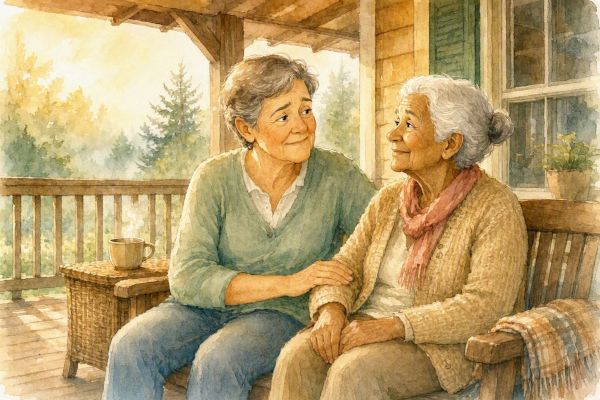
Our September 20th post is for anyone caring for a spouse, parent, or family member, and for anyone who loves someone doing that work. We cover the early warning signs of burnout, why caregivers so often minimize their own exhaustion until it's severe, and what respite care actually looks like in practice. We also share the local programs and support groups available to family caregivers here in Clackamas County.
|
|
|
|
Local Resource Spotlight: Family Caregiver
Support Program
|
If you read our caregiver burnout post last month, you already know we're big believers in this one. The Family Caregiver Support Program, run through Clackamas County, exists specifically for people caring for a family member, whether that's a spouse, a parent, an adult child, or another relative.
|
The program offers individual counseling to help you work through the emotional weight of caregiving, support groups where you can talk with others who genuinely understand what you're navigating, and hands-on help identifying respite care options so you can get a real break, even a short one. Staff can also help you sort through the practical side of caregiving that nobody hands you a manual for: how to talk with doctors on someone else's behalf, how to think through long-term planning, and how to find other local resources that might ease the load.
|
This isn't a program you have to be in crisis to use. It's meant for caregivers at any stage, including the early stage, when the role has just started to grow but hasn't yet become overwhelming. In fact, that's often the best time to call, before burnout sets in rather than after.
|
If you're caregiving in any capacity, even a modest one, it's worth a call just to know what's available before you need it.
|
|
|
|
|
|
Info Tip of the Month: Making Sense of the Medicare
Plan Finder Tool
|
Medicare Open Enrollment runs October 15 through December 7, and this year we want to focus on something practical: how to use the tool that compares your options.
|
The Medicare Plan Finder, available at medicare.gov, lets you compare Original Medicare, Medicare Advantage plans, and Part D prescription drug plans side by side, based on your specific medications, preferred pharmacy, and doctors. It sounds simple, and the tool itself is well designed, but a few tips make it far less overwhelming:
|
- Have your current medication list ready, with exact dosages, before you start. The tool uses this to estimate your actual yearly drug costs under each plan, which can vary more than you'd expect.
- Enter your preferred pharmacy. Some plans offer significantly lower costs at specific pharmacy chains, and this won't show up unless you specify it.
- Don't assume last year's best plan is still this year's best plan. Plans change their costs and covered drugs every year, and so might your own health needs.
If you get stuck, you don't have to figure it out alone. SHIBA counselors can walk through the tool with you, step by step, for free.
|
|
Set aside twenty quiet minutes with your medication list nearby, and it's a much less intimidating process than it looks.
|
|
|
|
Health Tip of the Month: Recognizing Seasonal
Affective Disorder
|
As the days shorten, some people notice more than just a change in the weather. Seasonal Affective Disorder, sometimes called seasonal depression, is a real and treatable condition linked to reduced sunlight exposure during fall and winter months, and older adults are not immune to it.
|
Signs worth paying attention to include low energy that doesn't improve with rest, a loss of interest in activities you normally enjoy, changes in sleep or appetite, and a persistent low mood that seems tied to the season rather than any single event. It can be easy to write these off as "just the weather getting to me," but if they're affecting your daily life, they're worth mentioning to your doctor.
|
A few things that genuinely help: getting outside during daylight hours, even for a short walk, especially in the morning; light therapy lamps, which are inexpensive and available without a prescription; staying socially connected rather than withdrawing, even when withdrawing feels easier; and talking to your doctor if symptoms persist for more than a couple of weeks, since treatment options exist and work well.
|
|
If you've noticed this pattern in yourself in past years, this is a good month to get ahead of it rather than waiting until you're already in the middle of it.
|
|
|
|
Community Corner: Villages
|
A subscriber wrote in with a suggestion we wanted to share with all of you: "You should mention Rivers East Village. It's a virtual village, so not a brick and mortar village. Please check out their website. Villages are local so there are many options."
|
For those unfamiliar, the "Village" model is a grassroots approach to aging in place, built by neighbors for neighbors. Villages are typically member-driven, nonprofit networks that connect older adults with volunteers and vetted service providers for things like rides to appointments, help around the house, technology support, and social gatherings, usually for an annual membership fee. Some Villages are physical, neighborhood-based organizations. Others, like the one our reader mentioned, operate virtually, connecting members and volunteers over a wider area without a physical office at the center of it.
|
The Rivers East Village that our subscriber mentioned serves the Milwaukie/Gladstone area. It's one of ten in the Villages NW network. There is not currently a Village serving Happy Valley or Clackamas specifically. But we think the concept is a genuinely good one, and we're grateful to the reader who reminded us about it. If a Village model interests you, or if you'd be curious about what it might take to start one here, we'd love to hear from you. This is exactly the kind of community-building idea we hope to support as The Elder Beat grows.
|
|
Thank you, as always, for reading closely enough to send us something worth sharing.
|
|
|
|
Question of the Month
|
Every month we pose a single question to our community and invite you to respond. Selected answers appear in this newsletter. There are no right answers — only neighbors sharing what they know, what they have learned, and what they think. We love hearing from you.
|
|
A Response to the September Question
|
Last month we asked: If you could give one piece of advice to someone just entering their sixties, what would it be? One reader sent us this, and we're printing it close to how they wrote it, because we don't think it needs much editing:
|
"Do anything and everything to maintain a healthy lifestyle. Visit your doctor for regular checkups. Listen to your body and don't ignore new or unusual symptoms. Monitor your weight. Keep up with what is healthy and enriching to eat so your body can continue to purr. Exercise! It doesn't have to be gym style sweaty and exhausting exercise. A good long brisk walk is a great way to get those points. Hydration is paramount. Make sure you have plenty of water with you. Drinking water at home is also necessary. Drink it every day, all day long whether it's an exercise day or not. That's all I've got for now (I can hear the groans of glee)."
|
We laughed at that last line, and we also think it's excellent advice. Thank you to the reader who sent it in — and if you're someone who groaned reading it, that's usually a sign it's worth listening to anyway.
|
What is one local business, service, or resource in Happy Valley or Clackamas that you think more neighbors should know about?
|
|
We're always looking to expand what we know about this community, and we suspect many of you know about a hidden gem the rest of us have missed. To submit your response, visit the Question of the Month page on The Elder Beat website or write to us at info@theelderbeat.org.
|
|
|
|
Elder Beat Reads
|
|
Healthy to 100: How Strong Social Ties Lead to Long Lives
|
Ken Stern spent time traveling to communities around the world known for unusually high numbers of long, healthy lives, and came back with a conclusion that runs against a lot of conventional wisdom about aging well. It is not primarily diet, or exercise, or genetics that separates the longest-lived, healthiest older adults from everyone else. It is the strength and depth of their social connections.
|
Stern makes the case, backed by research and a wide range of on-the-ground reporting, that isolation is one of the most underrated health risks facing older adults, with effects on mortality comparable to smoking or obesity. He is careful not to dismiss the importance of physical health, but the book's real argument is that community, purpose, and regular meaningful contact with other people function almost like medicine, and that many of us under-invest in them precisely because they don't feel like health interventions.
|
For readers of this newsletter, the book lands close to home. It's a compelling companion to this month's Community Corner piece on the Village model, and to everything we believe about why The Elder Beat exists in the first place: connection is not a nice extra on top of aging well. For a lot of people, it may be the thing that matters most.
|
|
Available through the Happy Valley Library and at various online and local bookstores.
|
|
|
|
Coming This Month
|
October brings two posts we have been looking forward to sharing — and both come directly from the questions and experiences readers have brought to The Elder Beat:
|
- Technology Tools That Help Seniors Stay Safe and Independent (October 10) — We look at practical technology that genuinely helps, without requiring you to become a tech expert first: medical alert systems, medication reminder devices, simple video calling setups for staying in touch with family, and smart home features that can quietly reduce fall risk and support aging in place. We also cover what to look for, what to skip, and where to get hands-on help setting things up if the technology itself feels intimidating.
- Social Activities and Senior Centers in Clackamas County (October 20) — Following up on this month's Community Corner conversation about connection and community, we take a closer look at the senior centers, classes, and social programs already available in Clackamas County. We cover what a typical week looks like at a local senior center, how to try one out without committing to anything, and why regular social activity is one of the most protective things you can do for your long-term health.
|
|
|
Earlene on the Lighter Side
|
Meet Earlene. Because aging well includes laughing well — at life, at the absurdities of getting older, and occasionally at ourselves. We hope she brightens your day.
|
Chester had booked the reservation as an anniversary surprise: a new restaurant downtown, the kind with a tasting menu and no prices printed anywhere, which Earlene took as an ominous sign before they'd even sat down.
|
"Seven courses," Chester read aloud, delighted. "Look, this one's foraged."
|
"Foraged from where," Earlene said, not really asking.
|
The waiter arrived with the confidence of a man about to change her life. Course one was a single scallop balanced on something described as "ash." Course two involved foam. Earlene ate both, gamely, the way she might approach a crossword clue she suspected was a trick.
|
By course four, a small, dramatic mushroom arrangement, she leaned toward Chester. "I would like it noted that I'm doing this for you."
|
"Noted," Chester said, already reaching for her mushroom.
|
She made it through all seven courses with good humor and a straight face, praised the chef sincerely on the way out, and didn't complain once. But the next morning, Earlene stood at her own counter in her bathrobe, poured her cereal into her usual bowl, and ate it slowly, with something close to reverence.
|
"How was the fancy place?" a neighbor asked her later that week.
|
|
"Educational," Earlene said. "Ten out of ten. Never again."
|
|
|
|
A Closing Note
|
There's a particular comfort in October, the sense of battening down for the season ahead — bringing in the last of the garden, making sure the porch light works, checking in on the people you care about before the days get any shorter.
|
We hope this issue gives you one small thing to act on this month, whether that's a call to the Family Caregiver Support Program, twenty quiet minutes with the Medicare Plan Finder, or simply a walk outside while the afternoon light still holds.
|
Thank you, as always, for reading, and for being part of this community. If there is a topic you would like to see us cover, a resource we have missed, or a story you would like to share, our door is always open at info@theelderbeat.org.
|
— Molly Skeen
Founder, The Elder Beat
|
|
|
|

|
|
|
|
|
|
|
|